


Compatible with:

Ei1030 Radon Sensor
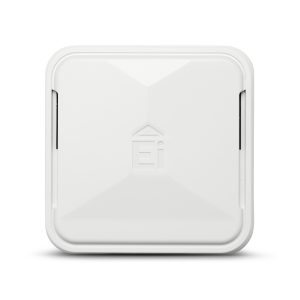
The Ei1030 is a wireless radon sensor that continuously monitors radon, temperature and humidity, taking readings every 15 minutes. Battery-powered and wall-mounted, it installs without wiring and connects to the Ei1000G Gateway, which sends data to the HomeLINK Dashboard.
Part of Aico’s connected home range, the Ei1030 provides long-term radon data rather than a single test result. It can be specified for new installations or added to properties that already have an Ei1000G Gateway fitted. HomeLINK software licence included.
- Continuous radon, temperature, and humidity monitoring.
- Readings taken every 15 minutes.
- Wire-free, wall-mounted installation.
- Sealed 6-year lithium battery, with no battery changes required.
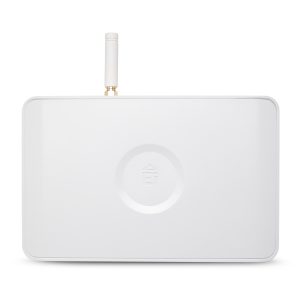
- Connects to the Ei1000G Gateway required to extract data.
- Available to purchase from the 16th of November

Product Description
Radon is a naturally occurring radioactive gas that enters buildings from the ground. It cannot be seen, smelt or tasted, so the only way to know the level in a property is to measure it.
In the UK, the Action Level for homes is 200 becquerels per cubic metre (Bq/m³), measured as an annual average, with a Target Level of 100 Bq/m³ after remedial work. UKHSA radon maps show where elevated levels are more likely, but concentrations can vary considerably between neighbouring properties depending on construction, ventilation and ground conditions.
Continuous radon monitoring with the Ei1030 gives a clearer picture than a one-off test. It shows how levels change over time, helps identify which properties need further investigation and confirms whether remedial work has reduced radon levels.
- Wire-free installation: Battery-powered and wall-mounted, with no mains wiring required.
- Wireless connectivity: The Ei1030 Radon Sensor communicates wirelessly with the Ei1000G SmartLINK Gateway, securely transferring data to the HomeLINK Dashboard.
- Continuous measurement: Measures radon, temperature and humidity every 15 minutes, building a long-term record rather than a single average.
- Data via HomeLINK: Readings are sent through the Gateway to the HomeLINK Dashboard, giving your customer a central view of radon levels across their properties.
For most homes, install two sensors: one in the living room and one in the main bedroom. Measuring two occupied rooms gives a more accurate picture of exposure than a single reading and follows the standard approach used in UK radon testing. Where a property has a basement or cellar, add a third sensor there, as rooms in contact with the ground can have higher concentrations.
Do not install the Ei1030 in kitchens or bathrooms, where high humidity and condensation can affect readings.
Technical Specification
- Sensor type: Radon, Temperature and Humidity
- Humidity Range (%): 15-95 Relative Humidity (non-condensing)
- Temperature Range (oC): -10 to 40
- RF range (m): >100 in free air
- RF frequency: 868.2 MHz (1% duty cycle)
- Battery type: 3V Lithium Battery (non-replaceable).
- Certifications/Approvals: RF performance to EN 300 220-1, in accordance with EN 300 220-2. EMC performance to EN 301 489-1, in accordance with EN 301 489-3. Safety to EN 62368-1
- Dimensions: D55 mm x W84 mm x H89 mm
- Weight (kg): 0.14
- Warranty: 5-year warranty
Related Products


FAQs
How long until the first reliable radon reading?
The Dashboard displays daily average readings as soon as the sensor is installed. A two-week calibration period improves measurement accuracy, while insights and the annual average will show at around two months of data capture.
Does Ei1030 need a HomeLINK subscription?
No, a separate HomeLINK subscription is not required. The HomeLINK software licence is included in the Gateway cost, allowing housing providers to access the HomeLINK Dashboard and its insights without an additional software subscription fee.
How many sensors can one Gateway support?
The Ei1000G Gateway can support up to 17 connected sensor serial numbers, with the Gateway itself also counted within the system. This means that, although 18 devices can effectively be accommodated, the stated capacity is 17 devices per Gateway, including the Gateway itself.
How long does a radon sensor last?
The Aico Ei1030 Radon Sensor is powered by a sealed 6-year lithium battery, so there are no battery changes during its working life. This makes it well suited to long-term monitoring across a housing portfolio. The sensor also comes with a 5-year warranty. Its data is sent wirelessly to the HomeLINK Dashboard via the Ei1000G SmartLINK Gateway, giving providers ongoing visibility for the life of the device. Full details are in the Ei1030 data sheet.
Where should a radon sensor be installed?
For most homes, it is advised to have two radon sensors, one positioned in the living room and the other in the main bedroom. This is due to residents commonly spending the most time in these rooms, and therefore, where they are most at risk to radon exposure.
This also mirrors the standard approach used in UK radon testing. If the property has a basement or cellar, it is advised to add a third sensor there, because rooms in contact with the ground can have higher concentrations. Across a portfolio, this lets housing providers compare conditions consistently from one property to the next.
What’s the difference between a radon test kit and a radon sensor?
A radon test kit is typically used in a home for three months and contains passive detectors. They are then sent to a laboratory for analysis, and the result is a single average reading for that period. A radon sensor such as the Aico Ei1030 measures radon continuously, along with temperature and humidity. Connected to the HomeLINK Dashboard, it shows how radon levels change over time. Housing providers can then spot elevated readings, decide where to investigate and check whether remedial work has made a difference.