Fire alarms are the first responders in the event of a fire, so it is essential to ensure you have satisfactory protection.
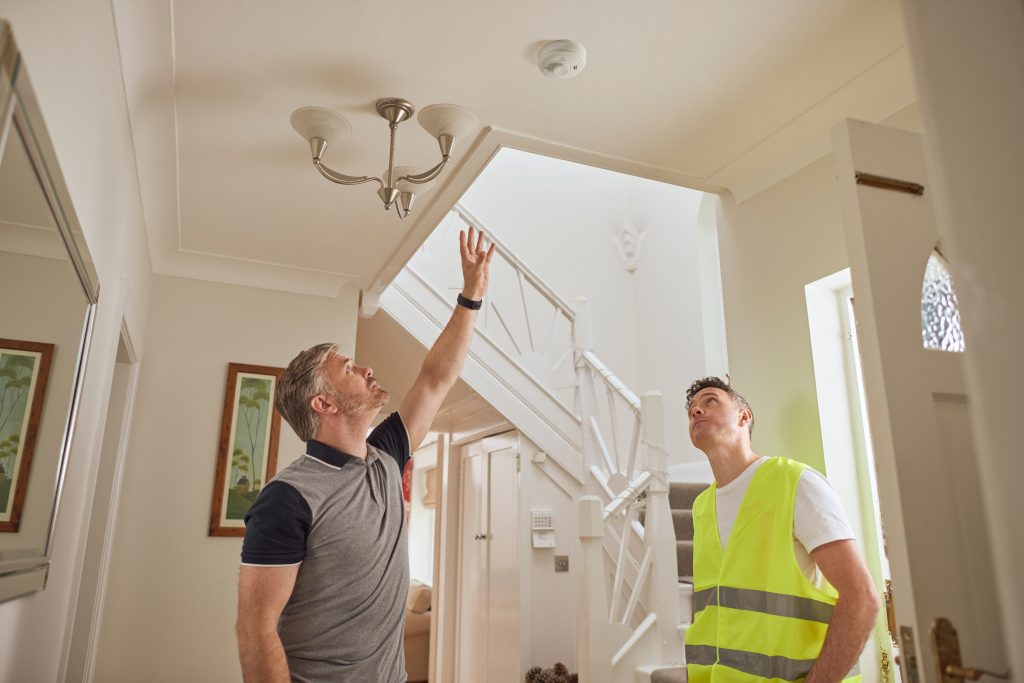
We recommend following the British Standards, which state that heat detectors should be installed in every kitchen and smoke alarms should be installed in the circulation space on each storey, e.g. hallways and landings. A smoke detector should also be installed in the principal habitable room, such as the living room.
There are four main power sources for fire alarms; mains powered with a replaceable battery backup, mains powered with a tamperproof battery backup, battery powered with a replaceable battery, battery powered with a sealed in battery.
Section 1 – What are Mains Powered Fire Alarms?
Section 2 – Advantages and Disadvantages of Mains Powered Fire Alarms
Section 3 – What are Battery Fire Alarms?
Section 4 – Advantages & Disadvantages of Battery Fire Alarms
Section 5 – Which is right for you?
Mains powered fire alarms physically connect to your home’s mains power supply, either from the distribution board or a local lighting circuit. This connection must be a permanent mains feed.
Many mains powered fire alarms operate with a back-up battery source, whether that be a replaceable 9V alkaline battery, or a rechargeable 10-year lithium-ion battery which would be the more favorable option as it will not need replacing.
Alarms don’t last indefinitely. As time goes by, elements can be worn down and not work to the full capacity. We recommend regular testing and replacement after, at most, 10 years to ensure adequate protection of your home.
All of our mains powered alarms have a battery back-up. This battery backup is important to ensure full operation of the alarm in the event of a mains failure.
British Standards will always recommend a hardwired alarm which utilises either a user-replaceable battery, or a tamper proof lithium-ion battery.
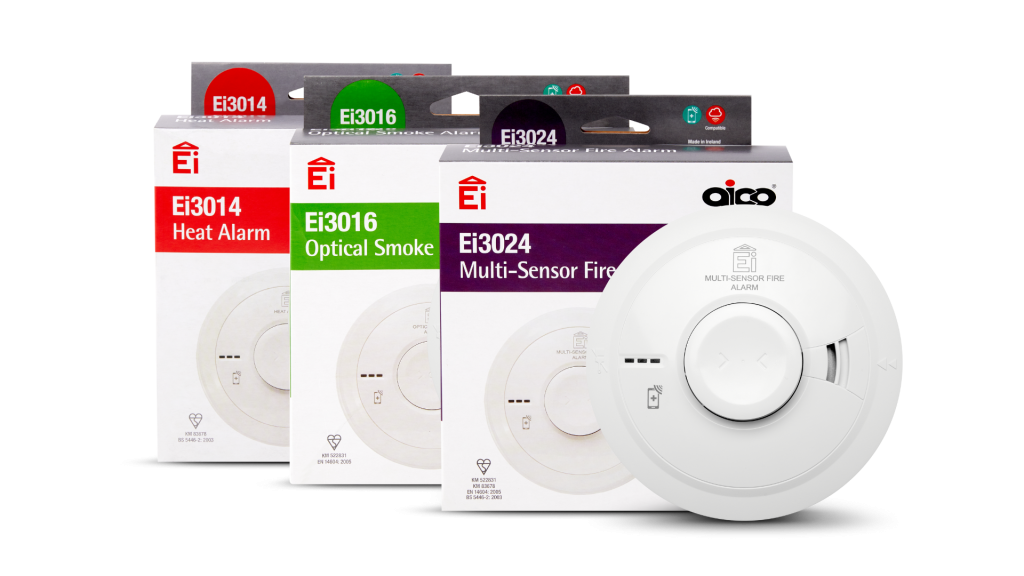
Mains powered fire alarms which have battery back-ups are far more reliable than solely hardwired, or solely battery powered. They allow for detection for a limited time following the absence of mains power. The battery back up (at full charge) is designed to last 72 hours as per manufacturing standards. However, when a connection to the mains power is not available, batteries in Aico (3000 Series) alarms can last up to 6 months with no mains power if without a module fitted, or up to 3 months with the Ei3000MRF module.
The drawbacks to mains powered alarms is that they require more attention when it comes to installation. As wiring is involved, you will need to call an electrician to install an alarm. Our 3000 Series and 140e Series alarms all use the same easi-fit base, making it easier to replace existing alarms as it’s just a matter of sliding the old alarm off, and the new alarm on, without the need to change the baseplate or rewire.
Battery-powered alarms operate solely with either a replaceable battery or a built-in lithium-ion battery. Our 600 Series alarms all feature 10-year lithium-ion batteries. These are tamperproof and will not need to be changed at any point in the alarm’s lifespan, making them hassle free and easy to use.
Battery-operated alarms are easy to set up, are smaller and don’t require a call-out for an electrician to install them. These alarms also don’t rely on mains power, and the 10-year lithium-ion battery will operate the full life of the alarm, meaning no battery change is needed.
If an alarm is operated solely with a replaceable battery, the battery will need to be monitored and replaced accordingly when needed as there is no secondary power source. There is also the risk of putting faulty or half charged batteries into the alarm which may compromise power levels. As a battery depletes, elements of the alarm can work at less than their full capacity and potentially affect sounding, detection, and interconnections with other alarms in the system.
Where the legislation for short-term lets such as Airbnb’s, holiday lets and guest houses can use battery powered alarms, they state this should only be a temporary measure of up to 3 years before upgrading to a Grade D1 (such as our 3000 Series) Category LD1 system.
A mains powered alarm with a tamper proof battery such as our 3000 Series would be the best practice option for alarms in most domestic properties, with it having a 10-year life, non-removeable standby battery and capable of being interlinked.
For ease of installation, a tamper proof battery-powered alarm, such as our 600 Series, would be a viable option. These alarms are smaller and more discreet, making them an aesthetically more desirable option for some homeowners. Our 600 Series alarms have a sealed in 10-year lithium battery, so you won’t need to change the battery at any point during the life of the alarm. We would recommend the radio frequency models, so that the system can be interlinked and enable all alarms in the property to sound when one is triggered.
Click here to find out which fire alarm is right for you with our virtual Product Selector.