Fire risk within domestic properties across the United Kingdom is evolving at a pace that regulation is increasingly struggling to match. Changes in how people live, work, and use technology inside their homes are reshaping the nature of domestic fire hazards, yet the regulatory framework governing fire detection in England remains largely anchored in assumptions formed decades ago.
The recent warning from the National Fire Chiefs Council that fire incidents are rising again should be seen as more than a statistical update. It is a clear signal that existing approaches may no longer reflect the realities of modern living. For policymakers, housing providers, developers, and fire safety professionals, this moment presents an opportunity to step back and ask a difficult but necessary question: are England’s current fire detection standards still genuinely fit for purpose?
A Changing Risk Landscape Inside the Modern Home
The domestic environment has changed profoundly over the past ten to fifteen years. Homes are no longer simply places of rest and family life. They now function as workplaces, classrooms, charging hubs, storage spaces, and entertainment centres, often all within the same footprint. This transformation has brought with it a far greater density of electrical equipment, energy storage devices, and charging infrastructure than was ever envisaged when many fire detection principles were first established.

Lithium-ion batteries are perhaps the most visible symbol of this shift. E-bikes, e-scooters, power tools, laptops, tablets, and mobile phones are now routinely charged inside living spaces and bedrooms. Alongside this, the widespread availability of low-cost, poor-quality, or counterfeit charging equipment has increased the likelihood of electrical faults. Overloaded extension leads and adaptors remain common, particularly in older properties where the number of available sockets does not reflect modern demand.
These hazards introduce a different type of domestic fire risk. Lithium battery fires can develop extremely rapidly, burn at very high temperatures, and produce dense, toxic smoke almost immediately. In many cases, the window between ignition and untenable conditions is measured in just a few precious minutes. This reality challenges long-standing assumptions about how and when fires are detected within the home.
Against this backdrop, it is increasingly difficult to argue that a static approach to fire detection remains sufficient.
England’s Current Regulatory Position
In England, fire detection requirements for new dwellings are primarily driven by Approved Document B of the Building Regulations. In most cases, compliance is achieved through the provision of a minimum Grade D2, Category LD2 fire detection and alarm system in accordance with BS 5839-6:2019+A1:2020.
Category LD3 coverage focuses detection on escape routes such as hallways and landings. The underlying principle is straightforward and historically sound: detect smoke early enough to provide occupants with sufficient warning to escape safely via protected routes.
There is no question that this approach has saved lives. For many years, LD3 represented a significant improvement on earlier standards and played an important role in reducing fatalities from domestic fires. However, it is equally important to acknowledge the assumptions on which this approach is based. Category LD3 relies on the idea that a fire will be detected once smoke reaches an escape route, allowing occupants time to react and evacuate.
In today’s homes, that assumption is becoming increasingly fragile. Many ignition sources are now located in living rooms, kitchens, bedrooms, and home offices, spaces that may not be directly protected under minimum LD3 provision. By the time smoke migrates into a hallway, the fire may already be well developed, particularly where fast-growing electrical or battery-related fires are involved.
The Role of British Standards and Best Practice
While Building Regulations establish statutory minimum requirements, they do not represent the full extent of industry best practice. That role is fulfilled by BS 5839-6:2019+A1:2020, which provides detailed guidance on the design, installation, and maintenance of domestic fire detection and alarm systems.
Crucially, BS 5839-6:2019+A1:2020 clearly recommends that new domestic installations should achieve at least category LD2 coverage. This recommendation is already referenced within Approved Document B, yet it is often treated as optional rather than aspirational.
LD2 expands detection beyond escape routes, including high risk areas such as kitchens and principal living areas. This represents a fundamental shift in philosophy, from detecting fires once they threaten escape routes to detecting them closer to their point of origin. The practical benefits of this approach are well established. Earlier detection provides occupants with more time to respond, improves survival rates, reduces the likelihood of serious injury, and significantly limits property damage.
In an era where domestic fires can escalate with unprecedented speed, the distinction between categories LD3 and LD2 is far from technical. It can be the difference between a manageable incident and a life-altering event.
Lessons from the Rest of the United Kingdom
One of the strongest indicators that England may be falling behind is the direction taken elsewhere in the UK. Both Scotland and Northern Ireland have recognised that domestic fire risk has changed and have responded with strengthened requirements and guidance.
In Scotland, enhanced fire detection standards now apply to all homes, regardless of tenure or age. The Tolerable Standard requires interlinked smoke alarms in living rooms, hallways, and landings, alongside heat alarms in kitchens. This approach effectively normalises a level of protection consistent with category LD2 principles and ensures that detection is present in the rooms where people spend most of their time and where fires are most likely to start.
The Scottish model reflects an important shift in thinking. Rather than focusing solely on traditional building layouts and escape routes, it recognises how homes are used. It acknowledges that fire safety must be aligned with real behaviour patterns, not historic assumptions.
Northern Ireland has followed a similar trajectory. Technical Booklet E for new builds has been strengthened, with all habitable room coverage now expected as standard. Additionally, the Private Tenancies Act (Northern Ireland) came into effect in 2024, which has similarities to the Scottish Tolerable Standard, however, only applies to privately rented properties. There is a clear emphasis on broader alarm coverage and improved interconnectivity, reflecting an understanding that early detection is central to modern fire safety strategy.
The contrast with England is becoming increasingly difficult to ignore.
The Rise of the Principal Living Space Risk
A defining feature of many modern homes is the dominance of a single principal living space. This may be a living room filled with electronic devices, an open-plan kitchen and dining area, a bedroom that doubles as a workspace, or a multi-use family hub where daily life is concentrated.

These spaces often contain the highest concentration of ignition sources. Multiple chargers, battery-powered devices, entertainment systems, and cooking equipment may all coexist within the same room. Yet under minimum LD3 provision, these areas may not always be directly protected by automatic fire detection.
If a fire starts in one of these rooms, detection may be delayed until smoke reaches a hallway or landing. In the context of fast-developing electrical fires, this delay can be critical. Toxic smoke can render escape routes impassable in a very short period, particularly during night-time hours when occupants are asleep.
This reality raises serious questions about whether detection strategies that prioritise escape routes over living spaces remain appropriate.
Minimum Compliance Versus Meaningful Protection
There is an increasingly uncomfortable conversation emerging within the fire safety sector. Building Regulations are designed to provide baseline protection, not optimal protection. They establish the minimum that must be done, not necessarily what should be done to reflect best practice or emerging risk.
The danger arises when compliance is mistaken for comprehensive safety. A dwelling that meets minimum regulatory requirements may still be poorly equipped to deal with the types of fires most likely to occur in modern living environments.
The NFCC’s warning that fire incidents are rising again should act as a catalyst for reassessment. If domestic fire risk is increasing, it is legitimate to ask whether existing minimum standards are still aligned with the threat profile they are intended to address.
Considering the Case for Category LD1
At the upper end of domestic fire detection provision sits LD1. This category provides coverage in almost all rooms, excluding only very low-risk areas such as bathrooms and small cupboards.
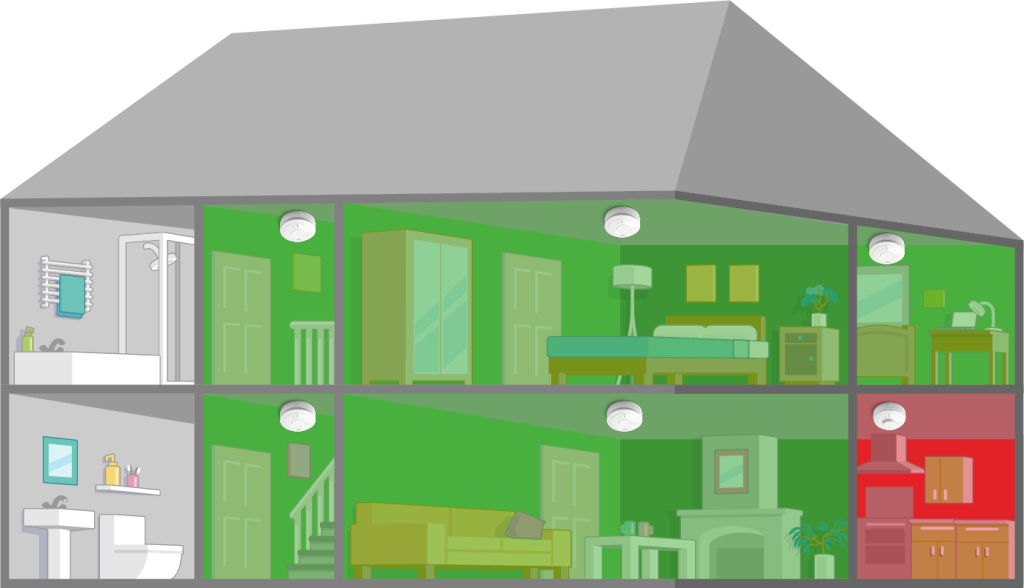
Adopting LD1 as a future benchmark would represent a significant shift in domestic fire safety philosophy. It would prioritise the earliest possible detection, maximising available response time and reducing reliance on smoke migration to trigger alarms.
The benefits are clear. Category LD1 offers improved protection against rapidly developing fires, greater resilience in the face of emerging electrical risks, enhanced safeguarding for vulnerable residents, and increased property preservation. In settings such as supported housing or accommodation with higher-risk occupants, these advantages are particularly compelling.
Concerns around cost and installation complexity are often raised in opposition to broader alarm coverage. However, technological advances are steadily eroding these barriers. Wireless systems, sealed-for-life batteries, and smart interlinked alarms have made higher levels of protection more accessible and less disruptive than ever before.
A Necessary Shift in Mindset
Historically, fire safety regulation in the UK has often evolved in response to major incidents. While this reactive approach has led to important improvements, it also means that change frequently comes after loss.
The rise in domestic fires linked to modern technology presents an opportunity to break that cycle. Rather than waiting for tragedy to drive reform, there is scope to take a proactive stance based on emerging evidence and foreseeable risk.
The question facing England should no longer be whether higher detection standards are achievable. It should be whether it is responsible not to consider them.
Leadership Beyond Legislation
Meaningful progress in fire safety rarely begins with regulation alone. It requires leadership from housing providers, developers, designers, fire safety professionals, and policymakers who are willing to challenge established norms.
Encouraging widespread adoption of category LD2 as a minimum expectation, rather than a best-practice option, would represent an important step forward. Exploring LD1 as a future benchmark, particularly in higher-risk settings, could further strengthen domestic fire protection across England.
Such leadership would send a clear message that fire safety is not merely about compliance, but about genuinely protecting lives in a changing world.
Reconsidering What “Safe” Really Means
The NFCC’s warning should not be viewed in isolation. It is part of a broader pattern that reflects how domestic fire risk is evolving alongside modern living. Scotland and Northern Ireland have already acknowledged this shift through stronger requirements and guidance.
England now faces a choice. It can continue to rely on existing minimum standards rooted in historic assumptions, or it can re-evaluate what meaningful protection looks like in today’s homes.
Ultimately, fire detection should do more than help people escape once a fire is established. It should help prevent fires from becoming life-changing events in the first place.